

Legality of Macdonald Statue Removal Questioned in Kingstonians’ Bid for Restoration
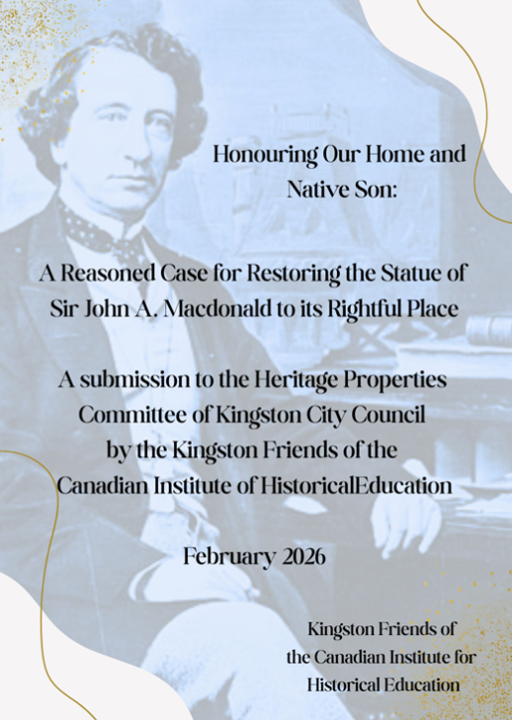
Sir John A. Macdonald, a Kingstonian, was the co-founder of Canada, the country’s first prime minister, the country’s second-longest serving prime minister, and the man who built the national railroad bringing the country together from coast to coast.
His reputation came into question when he was unfairly associated with residential school abuse at a time when mass graves of indigenous children were believed to have been discovered. The group contends several issues:
1. That then Kingston City Council moved hastily in removing the statue of Sir John A. Macdonald four days after hearing from some Kingstonians who were offended by it, after the statue had stood proudly and without contention in City Park for one hundred and twenty-six years.
2. That despite individual perspectives, toppling iconic symbols of national achievement does little to bring about constructive change in Canada. As Charlotte Gray, one of Canada’s most respected historians and biographers wrote, “How do we modernize the telling of Canadian history without vandalizing it?”
3. That when then Kingston City Council removed the statue, it violated both the Sydenham District Heritage Conservation Bylaw and Plan (No. 2015-67) in five different ways, and the Ontario Heritage Act in seven others.
4. That the current Kingston City Council has an opportunity to correct these violations and this injustice to Kingston’s and Canada’s history, by restoring the statue to its rightful place, and adding QR codes with educational materials to provide a balanced understanding of the man, his legacy, and Canada’s history at the time, from all perspectives.
As Greg Piasetzki, a senior fellow at the Aristotle Foundation wrote: “…tearing down or boxing up his statue doesn’t just erase a man, it erases our shared memory and history. Statues are not about sainthood. They are about significance and shared challenges that have been overcome. Macdonald led Canada into existence. He held it together through rebellion, war and economic depression. The reappearance of his statue at Queen’s Park is not the end of the conversation. It should be the beginning, with a plaque that tells the truth — good and bad — and with school curricula that examine his record in full.”
ABOUT CIHE (https://cihe.ca/)
The Canadian Institute for Historical Education (CIHE) promotes historical literacy
through research, education and engagement in the public square.
The CIHE ensures that the “renaming” of places and potential changes to historical
markers reflects a fair and balanced treatment of our past and that relevant facts and
context inform these decisions. The organization works with historians to provide
decision makers with easy access to relevant existing historical evidence and analysis,
commissions new research on Canadian history, and acts as a catalyst for a more
informed understanding amongst all Canadians.
Mark O’Farrell, Chair,
Kingston Friends of the Canadian Institute for Historical Ed
+1 866-686-9090
mark.ofarrell@ThePFSI.com
Legal Disclaimer:
EIN Presswire provides this news content "as is" without warranty of any kind. We do not accept any responsibility or liability for the accuracy, content, images, videos, licenses, completeness, legality, or reliability of the information contained in this article. If you have any complaints or copyright issues related to this article, kindly contact the author above.
